Showing posts with label Dark-eyed Junco. Show all posts

Thursday, August 2, 2012

Up the Mountains

When I was a youngster living outside Philadelphia - we went "down the shore" so I guess now that I live in Colorado - we go "up the mountains." It's a beautiful day - but still warm, so we decided to do a little birding with altitude.

Dark-eyed Junco
Dark-eyed Juncos are common among the pines in the mountains.

Mountain Chickadee
 We have two types of chickadees: Mountain Chickadees and Black-capped Chickadees. The Mt. Chickadee has a dark line through his eye.

Mountain Chickadee
 Rampart Range Road is still closed because of the Waldo Canyon Fire, so we went to Woodland Park and over to Farish, the recreation area of the Air Force Academy.

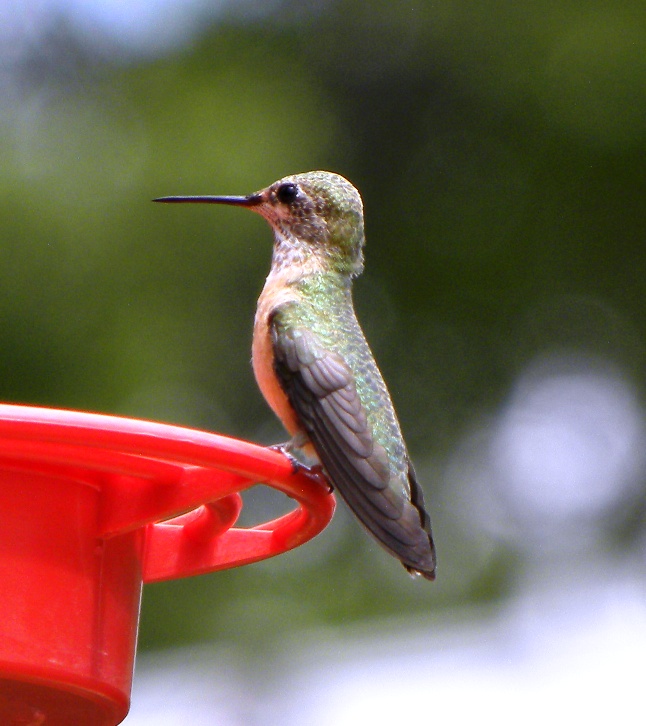
Broad-tailed Hummingbird
 The store and registration station had an empty hummingbird feeder hanging on their porch. Lots of little birds were stopping by - but left disappointed, so I told the man on duty and he filled it - much to the delight of the birds. He said they have to fill it 3 or 4 times a day and that this time of year they go through 20 pounds of sugar a week!!

The next three pictures were taken in a beautiful meadow near a pond. There were hummingbirds and wildflowers everywhere!


Lark Sparrow
 Bill spotted this Lark Sparrow along the trail.

Steller's Jay
 We've seen Steller's Jays before - but I've never been able to get a good picture. I told Bill this was my goal for the day - and he came through for me! Don't you love his top-notch!

Steller's Jay

Raven
Black birds are boring, but this guy was huge! Ravens look like really big crows - with more thickness in their bill.

We had a nice ride but wanted to get back down Route 24 before the afternoon thunderstorms that have been causing severe mud slides. Route 24 has been closed almost daily. Even a small amount of rain on the Waldo burn scare is causing major flooding. It just started raining and, sure enough, the emergency scroll is again running along the bottom of the TV screen.

Saturday, July 7, 2012

Birding in the Upper Huerfano River Valley
And THREE Life Birds!

Yesterday we decided to get away from the lingering smoke and ash and head south to one of our favorite places - the Huerfano River Valley. We packed a picnic lunch and met up with daughter Laura and her hubby Tim at o'dark thirty for the drive south on I-25 to Walsenburg. After an always delicious breakfast at George's, we turned west, past Gardner and the Singing River Ranch (that recently sold for 6-million dollars!) into the high elevation (above 10,000 feet) San Isabel National Forest. The road is long and bumpy - but the views are sensational. 

While Laura and Tim hiked back towards Blanca Peak and Mt. Lindsey to do some fishing and gold-panning in the Huerfano River, Bill and I took our time on the trail and looked for birds. We were not disappointed!

Wilson's Warbler (female)
We found a spot with lots of little yellow birds flying around and spent a couple of hours getting pictures and trying to identify them.

Wilson's Warbler (female)
 Our first new Life Bird was the Wilson's Warbler. It's diet is insects - and only insects.

Wilson's Warbler (male)
 The male Wilson's Warbler has a black cap on his head and at first look, we thought it was an American Goldfinch - but the goldfinch cap is over the forehead and they have black wings.

Wilson's Warbler (male)
 Beautiful little birds!

Audubon's Warbler (male)
 The Audubon's Warbler is a subspecies of the Yellow-rumped Warbler.

Audubon's Warbler (female)
Lincoln's Sparrow
The Sparrow with the Mohawk! When I was on Sanibel with my sister, Beth, there was a Lincoln's Sparrow  near the beach - but I missed it. My sister didn't and got a great picture. I was jealous. On this trip, we saw several sparrows flitting around, but it wasn't until I got home and checked my pictures that I was able to make final identification. The Lincoln's Sparrow was our third Life Bird of the day!

Dark-eyed Junco
 We saw a couple of other favorite birds - a Dark-eyed Junco, a Ruby-crowned Kinglet and a spectacular Western Tanager.

Western Tanager (male)
Ruby-crowned Kinglet
 The red spot on the head of the Ruby-crowned Kinglet is hard to see and nearly impossible to photograph. Without it, the bird is plain.

After a couple of hours, the rain started coming over the peak so we headed back to the car and were soon joined by Laura & Tim. We headed down the road and picnicked in  a rustic campground by the river. This fawn was by the road.

Wednesday, August 11, 2010

Miscellaneous Pictures

The Mountain Chickadees that took up residence in one of our bird houses are long gone, so we took off the door to clean it out and get it ready for a new family.

Inside we found layers of nesting materials - most of it from the "furniture store" I set out for them. The top was covered in soft cotton yarn-like material. There were no signs of feathers, egg bits, food or droppings. They were excellent house keepers. I'm not sure if you're supposed to clean out birdhouses - or leave the nest for the next visitor, but we decided that's why the houses come with doors that open - so we removed all of the nesting material and hung up the "For Rent" sign.

We have several planter boxes around our patio that we plant each year with annuals. I think these are especially pretty this year. We usually have great luck with Pansies - but this year they did not grow well at all.

On one of our hikes in Palmer Park we were excited to see several Western Tanagers. They visit our yard each May for a week to 10 days and after they leave, we don't usually see them again until the next Spring.

The Western Tanagers are Bill's favorite Colorado bird. I think the Painted Bunting is his favorite Florida bird. I like them all and my favorite is usually the last one I saw.

Mr. Squirrel is still protecting the yard - but lately he has not been doing such a great job. We have a very naughty gray kitty who visits early in the morning and lays in the yellow flowers around the birdbath. Twice we've spotted him just as he leaps into the air - catching one of my birds.

Next time I see him I'm going to put a note on his collar: "I'm a very bad kitty. Please keep me home so I don't kill any more of the neighbors pretty yellow birds."

Think that will work? I didn't think so either...

We've seen this female Bullock's Oriole several times - but no sign of a male. I even went out and bought a new feeder - especially for the Orioles - hoping to keep them around. Since it is filled with sugar water, the hummingbirds think it is for them.

The hummingbirds are thick. Each evening they delight us with their acrobatics as they try to keep each other away from the feeders. Since we have 3 feeders with sugar water, there is plenty of seating for everyone - but they still defend what they think is their exclusive territory. The male Broad-tailed Hummingbirds make a buzzing noise with their wings when they fly and some evenings they are so loud we need to turn up the television. Then again, maybe we need to turn it up because we are getting hard of hearing. Old age - the best of times, the worst of times (but certainly better than the alternative!)

My camera is in the shop for repairs and I really miss it when the hummers are everywhere. These pictures were taken before my camera broke.


While Geocaching in the park, we spotted this Downy Woodpecker. They haven't been around the yard much this year, so I always appreciate getting to see one.

This is another bird we don't see too often - a Dark-eyed Junco. This one was flitting around the trail when we hiked at Dome Rock State Park outside of Divide, Colorado.

I've been trying to get a decent picture of a Steller's Jay but this is the best I have so far. We only see them at higher elevations and this one was in Rocky Mountain National Park.

After our drive through Rocky Mountain National Park, we stopped in Grand Lake to see the water birds. At this point, my camera was not working well so the pictures of the rest of the large flock of White Pelicans did not turn out. This one is a youngster. I'm not sure what the shorebirds in front of the Pelican are since my books tell me only the Spotted Sandpiper is found in Colorado - and these look bigger than 8 inches. Maybe my sister Beth will know. Beth?

I forget where I took this picture - maybe at one of the lakes just outside RMNP.

The mammals we see in the mountains are, I am told, marmots - but look at these two pictures. They do not look like the same animal. The first picture was taken in Palmer Park.

This picture was taken in Rocky Mountain National Park and there was an informational sign nearby describing it as a Yellow-bellied Marmot. Another mystery!

The flowers at 11,000 feet are quite different than those at 5 or 6,000 feet. They are much smaller and shorter and often grow beside boulders that protect them from the strong winds.

Look at these growing on the rocks!

Such a beautiful rock garden.

And another...

I don't know which I like more in this picture - the neat fence or the view of the mountains. This is Long's Peak and I took it on the Peak to Peak Highway between Central City and Estes Park.

Okay, that's all the pictures I have until my camera is fixed. This weekend we are heading south to the Huerfano River Valley for 2 days of tent camping on the backside of Mount Blanca - and me without a camera!

Friday, June 19, 2009

Bumps on the trail

Yesterday, Bill and I took what we thought would be a simple hike in Palmer Park. It was a beautiful, hot day and we got a late start as I had an earlier appointment with the hematologist and then had to go visit the vampires to have blood drawn. Since I am taking Coumadin to prevent blood clots associated with Factor Five Leiden, my blood is checked on a regular basis.

Hiking was tough. I was tired, hot and thirsty. We had packed a lunch and Bill had his backpack filled with water - but neither seemed to help.

Along the trail, we spotted this House Wren building his nest. I was grateful for the rest while we took pictures. This one isn't very good, but if you look closely, you can see the wren behind a large branch, with a stick in his mouth at the entrance to his hole in the tree. He had to turn his head a couple of times to get the stick inside - but he did. Male wrens select three possible nesting sites. The female chooses the one she wants to use - and then they finish lining it with softer material before she lays her eggs.

This looks like a dandelion ready to fly its seeds where ever the wind blows - but it isn't. This seed puff was almost four inches across! I don't know what it was - but it was neat.

We finally got back home three hours after we started. I went directly to bed and slept soundly for two hours. We have no idea why I was so tired - but the nap and lots more water seemed to take care of what ever it was.

Today, I was anxious to get back on the trail - just to prove I was okay. We went to Cheyenne Canyon to hike up Mount Cutler. It's about a mile to the summit starting at an elevation of 6785 feet and climbing to 7200 feet. This is a picture of the view about half way to the top.

The trail was not difficult - an easy climb on gravel and dirt. The trail is well used and we passed quite a few other hikers.

Bill is almost to the top.

The views of Seven Falls below - in the distance - are amazing. You can see three of the seven falls in this photo.

This is the view at the top. I wish the pictures did it justice. We stopped to sit on a fallen tree and have our lunch - chicken sandwiches, trail mix (with bits of chocolate), cinnamon chips and lots of water. Nothing ever tasted so good.

When we hike, we take ski poles that Bill altered to make into hiking poles. They make climbing hills much easier. He carries a back pack with a 2 liter water bladder, extra camera batteries, lunch, rain gear (ponchos from the Dollar Store), toilet paper (and zip-lock bags to carry out what we use), a few dollars and his cell phone. We both carry binoculars and cameras. Thanks to a local yard sale, I now have a back pack and will carry over-shirts or jackets and more water for the longer hikes.

The view was spectacular, but we needed to head back down. I didn't know it at the time, but Bill was starting to get a migrane - maybe triggered by the chocolate - and he didn't have his pills.

I had just about given up hope that we would see any new birds, when this small Dark-eyed Junco caught my eye. Several junco species have been lumped together and called Dark-eyed Juncos. This is the gray-headed variety with a prominent rufous (orange) patch on his shoulders.

Just after stopping to photograph the junco, I slipped on the gravel on a steep hill and fell on my butt. All I hurt was my pride - but Bill had to help me up. At least he didn't take a picture first.