Showing posts with label Ruddy Turnstone. Show all posts

Monday, January 6, 2014

Birding the Jacksonville Area Beaches

Many of the birders we met at Little Talbot Island State Park where we saw the celebrity Snowy Owl were also looking for other rarities that were recently spotted in the area. We gathered information and headed to Huguenot Memorial Park just up the road to see if we could find the Snow Buntings that have been reported. The tide was still too high to drive on the beach so we got lots of exercise.


We never found the buntings, but saw lots of ducks. The profile of a Merganser is unmistakable. There were hundreds of Red-breasted Mergansers swimming in a large tidal pool across the dunes from the beach. They were quite far away.


I saw this lone Grebe among the ducks. It must be a Horned Grebe but it sure looks like the Western Grebes I see in Colorado.


There was different activity on the beach - and lots of it!


I like the silhouette of the ship in the background.


On our way out of the park we saw some of the regulars. There were lots of Osprey...


Mockingbirds...


and a Wood Stork keeping guard while a Big Blue Heron fishes down in the ravine. It was still early so we decided to head further north to Ft. Clinch State Park located on a peninsula on the outermost point of Amelia Island to see if we could see the Harlequin Duck that has been seen at the end of the pier.


The pier was long (lots of exercise!) and the water was choppy. There were several Black (or American) Scoters swimming near the pier - a Life Bird for us both.


The Harlequin Duck had been swimming too far out to see without a scope - but swam in just as we arrived to the delight of the birders on the watch. He actually swam along side the pier towards the beach diving in the rough waves next to the rocks for as long as we were there.


Another Red-breasted Merganser.


 The water was clear enough that we could see his feet and he was close enough that many of the birders with enormous lenses had to change them out. My lens was perfect.


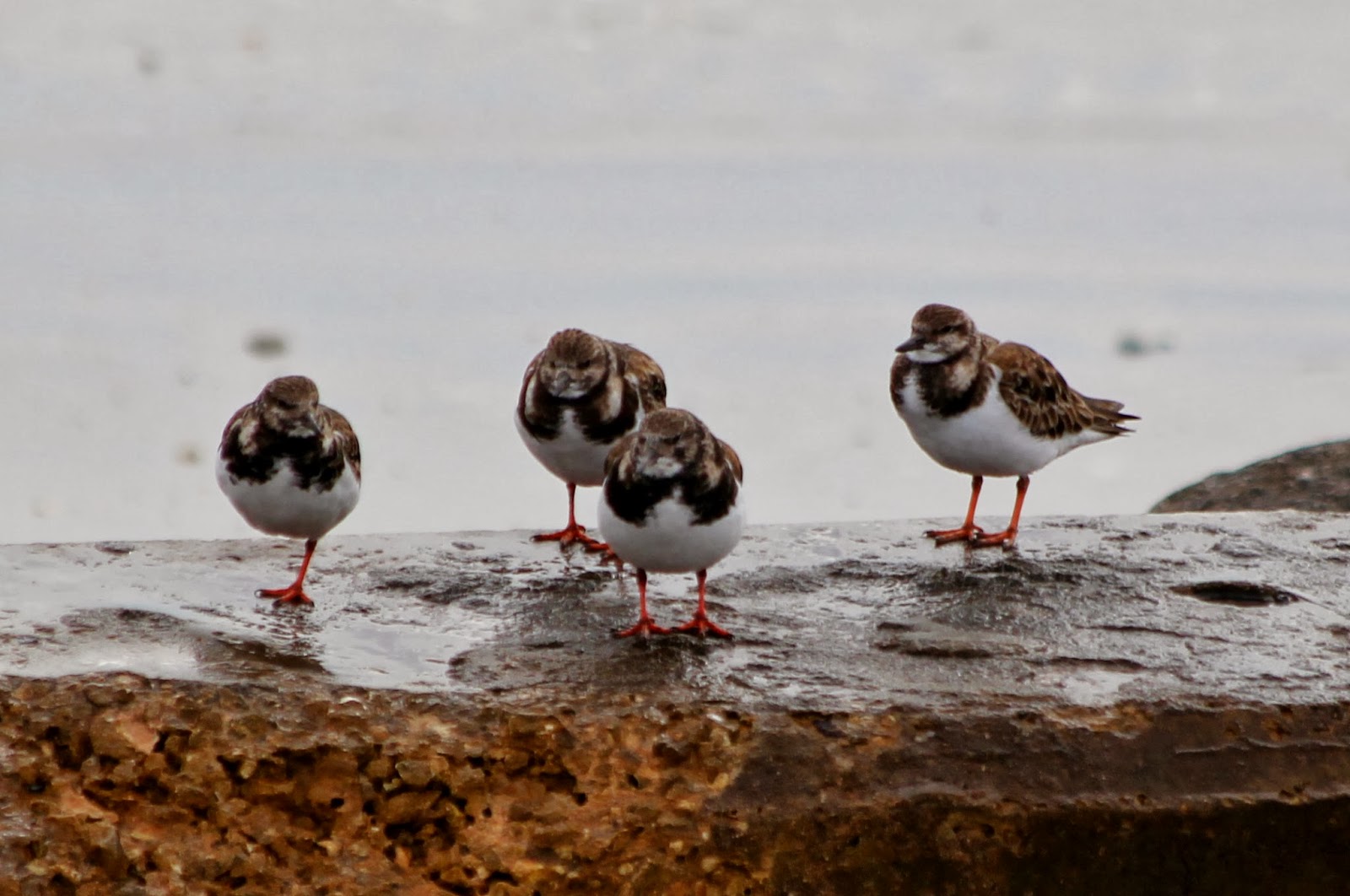
All along the jetty we saw dozens of Ruddy Turnstones.


While I was watching the Turnstones a Purple Sandpiper hopped up on the wall! Yet another Life Bird!


The Purple Sandpiper didn't stay in view very long but while he was there the cameras were clicking like crazy (mine included!)


Fort Clinch Beach is a prime nesting area for Black Skimmers and the beach was loaded with them! Bill and I had an amazing birding day in the Jacksonville area - but I just might have to go back and try to get a picture of the Snowy Owl with her eyes open! On our way home we spotted the Scissor-tailed Flycatcher sitting on the wire near the Ocala Regional Sportsplex - but I was too tired to get out the camera and Bill was too tired to stop.

Tuesday, December 13, 2011

Down the Shore

Apparently, I sound like a Philadelphian. People will stop me mid-sentence and ask where I'm from. Bill still teases me when I say "water," and "chotskies." When we were kids, we went "down the shore" which is apparently a very localized phrase - but it sounds right to me - and that's just what we did!

I love this picture! The Ruddy Turnstone looks like it's admiring itself in a mirror.

I wish you could see the bright yellow feet on this Snowy Egret.

As always, the Sanderlings were playing at the ocean's edge - running back and forth as the waves licked the sandy beach.

I always have to look up the plovers to see which one it is. This one, I believe is a Wilson's Plover.


This Pine Warbler doesn't belong on the beach! But I liked the picture.

Thursday, February 24, 2011

Birding at Cedar Key

The town of Cedar Key is a quaint fishing village on the Gulf Coast, about 50 miles southwest of Gainesville. The Cedar Keys are a group of barrier islands that are Federally protected bird and wildlife sanctuaries.

This picture was taken from the dock where we were waiting to depart on a birding trip through the marshes with expert birder Captain Doug. The birds flying over the hotels are Black Skimmers.

A large flock of Black Skimmers.

I caught this pair as they were flying to sit on the hotel roof with the rest of the gang. Note that their lower bill is longer than their upper. They feed by flying low and skimming the water with their lower bill.

The ever-present Ring-billed Gulls.

Once we were out in the boat, I saw more shore birds than I ever saw in South Florida. There were hundreds of huge White Pelicans.

The distinctive black markings on their wings show only when they fly. I was amazed how close we were able to get to them.

Oystercatchers were everywhere. It was high tide and every inch of every available sand bar was covered with shore birds.

Oystercatchers and Willets. The Willets also have a very distinctive black and white wing pattern when they fly.

Willets, Willets and more Willets - but note the bigger bird with the long downward curved bill. It is a Wimbrel.

Another Wimbrel. The two smaller birds facing in the same direction as the Wimbrel are, I believe, a Short-billed Dowitcher (center) and a Dunlin.

A little of everything - can you name them all? I can't!

A couple of the sand bars were wall-to-wall Ruddy Turnstones.

Captain Doug promised us Plovers and we found these way out on a secluded beach. The one on the right is a Semipalmated Plover. I'm not sure if the other two are also Semipalmated or another plover.

Close-up of the Semipalmated Plover showing the necklace that goes all the way around.

I didn't expect to see a Loon on this trip!

The larger bird with the long black and pink bill is a Marbled Godwit.

We saw a couple of Bald Eagles during our 3 hour trip.

Back on land, I saw this Yellow-bellied Sapsucker.

We met another couple on our trip, Linda and Graham, and joined them for dinner at Tony's. Tony has won the gold ribbon for his clam chowder two years in a row - and after eating it I sure understood why! It was the BEST clam chowder I've ever had. Bill had fresh raw oysters and he said they were delicious. We have a new favorite place to eat!

We had a great day at Cedar Key - and I can't wait to go back.

Sunday, February 7, 2010

Sanibel Beach Day

Our good friend Mo from the Arctic Tundra (Denver) is here visiting for a week so we have been showing him the sun and sights of our little piece of paradise here in Fort Myers. On Thursday we headed over the $6 causeway to visit Sanibel, Ding Darling and the beautiful sandy beaches.

The most interesting thing we saw at Ding Darling was a Snowy Egret feeding frenzy. There were dozens of pairs of bright yellow feet flashing in the morning sunlight and jumping into the shallow water looking for small fish. An occasional Ibis and two or three Great Egrets joined them. Other than that, we didn't see anything special - a couple of Roseate Spoonbills way off in the distance - but not even one White Pelican. The earlier cold snap and hard freeze has had an effect on the Florida wildlife.

The beaches of Sanibel are wonderful. We set up our chairs, sat in the sun, waded in the surf and took a long walk up the shell-laden beach. This Willet watched as we walked in the bright sun.

Even this Snowy Egret was enjoying the day.

An industrious Ruddy Turnstone was busy turning over shells looking for any tasty morsels left behind.

Bill worked for quite some time trying to get a good picture of this beautiful Roseate Turn as he flew back and forth over the water looking for small fish.

When he spotted what looked like lunch, he dove into the water.

I wish we had a better picture showing his long forked tail and streaming feathers that were almost as long as his body. Roseate Terns are endangered in Canada and most of their range in the Northeast - but not here in Florida.

This shot leaves little question as to how the Ringed-bill Gull got his name.

One would think it is easy to identify a gull when he poses so nicely - but I find it very difficult because of the different seasonal plumages. I've decided this is a Laughing Gull with his winter coat. In the summer, his head will be all black.

The White Ibis are just starting to show their breeding colors. His bill and legs will get bright red over the next couple of months.

I had to check in all of my books to tentatively identify this bird as a Black-bellied Plover, again with his dull winter plumage.

Usually birds of a feather flock together but this Sandal-toed Plover was all by herself - soaking up the warm sun and enjoying the day. We did too.